Faith Ringgold’s story quilts kept painting present while adding fabric, stitching, and written narrative. Following dated works and their materials offers a way to understand a medium change without reducing it to a career label.
Start with the sequence
The Smithsonian biography traces sewing learned from her mother, Madame Willi Posey, to their collaboration on soft sculptures and unstretched paintings by 1972. Ringgold made her first quilt with her mother in 1980; by 1983, she had begun writing stories directly onto painted quilts.
This sequence establishes intermediate forms. It documents development without explaining every decision or establishing one exclusive motive.
Look for painting inside the quilt
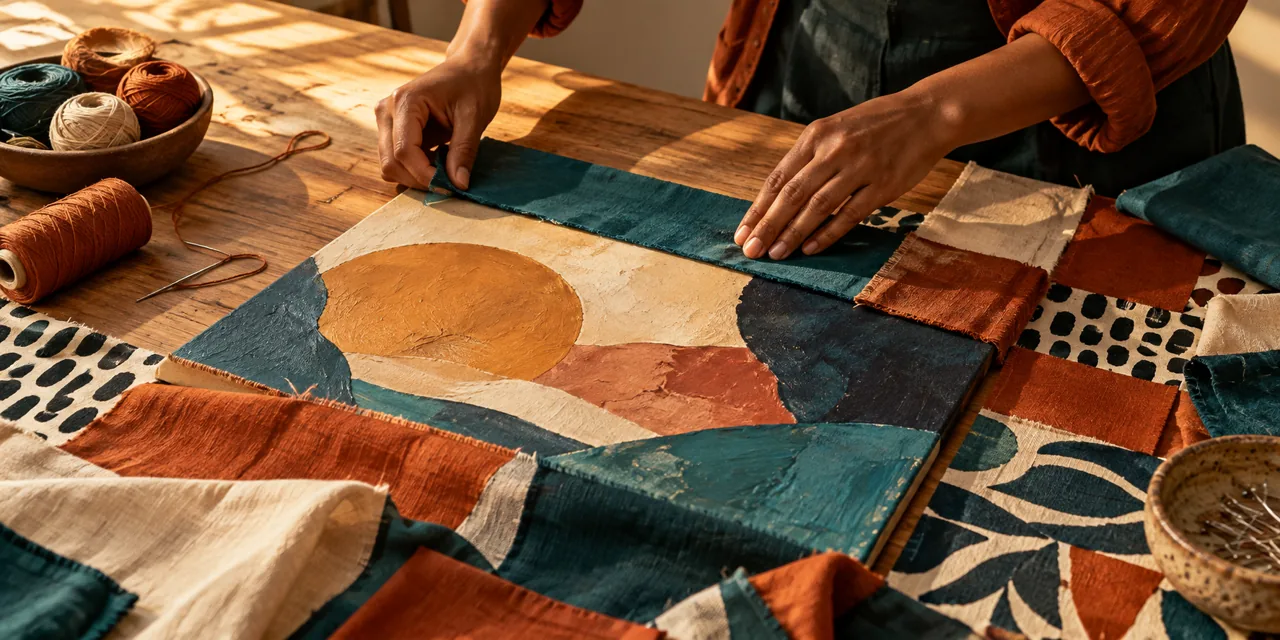
The Met identifies Street Story Quilt (1985) as Ringgold’s fourth quilt, following experiments with unstretched fabric paintings. Its three parts combine acrylic, ink marker, dyed and printed cotton, sequins, and cotton flannel backing.
Painting remains materially present. The useful question becomes how its relationship with fabric changes the work’s construction. A new medium label alone cannot describe that continuity or account for the whole painted object.
Follow the story across the surface
The Smithsonian records The Bitter Nest, Part II: The Harlem Renaissance Party (1988) as acrylic on canvas with printed, dyed, and pieced fabric. It identifies the work as the second episode in a five-part narrative, with side panels participating in the family story.
That description directs attention beyond the central image. Reading the surrounding panels alongside the painted surface makes the work’s organization part of the inquiry into how its narrative unfolds.
Separate materials from interpretation
The Guggenheim’s press kit lists acrylic paint, canvas, printed fabric, ink, and thread for Woman on a Bridge #1 of 5: Tar Beach (1988), opening a five-part cycle about fictional Harlem girl Cassie Louise Lightfoot.
Its account connects quilting with craft traditions and departure from academic conventions. This is museum interpretation, distinct from materials or artist testimony. The May 9–September 14, 2025 exhibition is past; the document supplies historical context, not current visiting information.
A method for reading a medium change
Begin with dated works, then inspect the materials and structure of each example. Ask what continues, what enters, and where the work directs attention. Read the painted surface alongside its support and surrounding panels before deciding what a new medium has added.
Keep evidence categories separate. An object record establishes materials; a curator proposes their significance. Neither automatically supplies the artist’s exclusive motive. The records reviewed as of October 24, 2026, support continuity while leaving intentions partly unresolved.
For another approach to museum context, see Is RM’s SFMOMA Show Worth Visiting Without BTS? The shared reading habit is to examine what the available evidence actually supports. Here, construction provides the starting point: follow the relationship between painting, fabric, and narrative before allowing a career label to settle the interpretation.
Sources
- Smithsonian American Art Museum: Faith Ringgold — biography, 2024.
- Smithsonian American Art Museum: The Bitter Nest, Part II — collection record, artwork dated 1988.
- The Metropolitan Museum of Art: Street Story Quilt — collection record, artwork dated 1985.
- Guggenheim: The Reach of Faith Ringgold — press kit dated May 7, 2025.