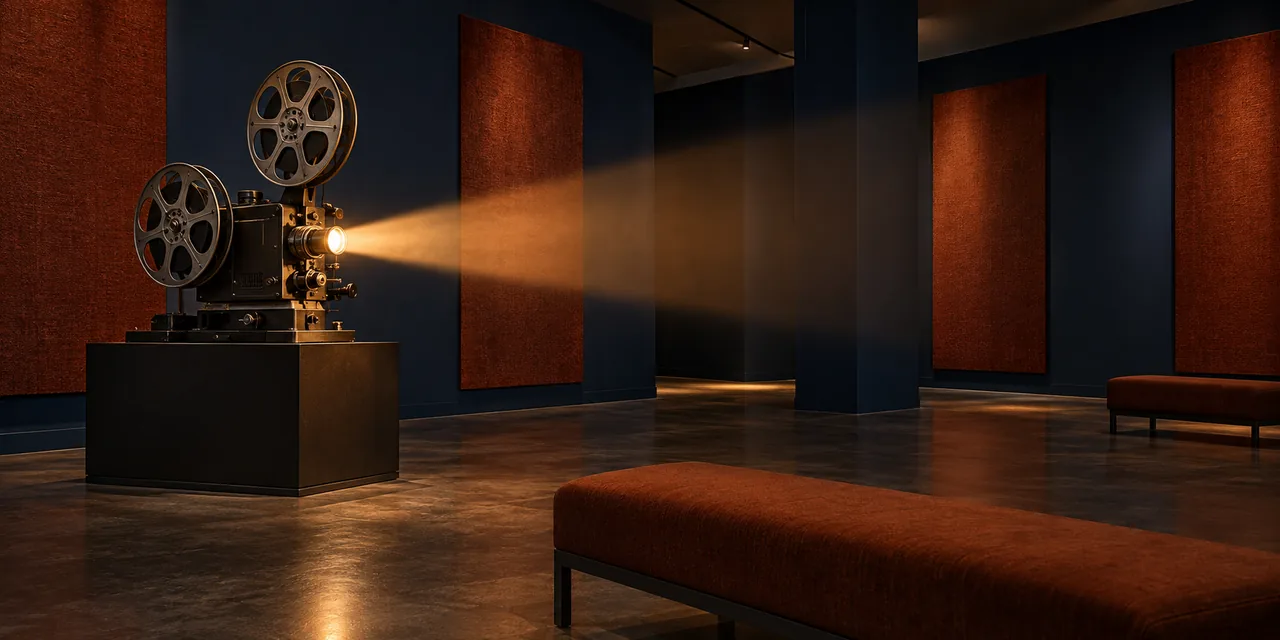
Start a silent film by checking what version you are watching, then give its movement, title cards, framing, and music your attention separately. That approach helps distinguish what you can observe from what requires documentation. In its account of restoring Hitchcock’s silent films, the BFI describes research into surviving materials and appropriate speed, rather than a single automatic recipe. The practical lesson is to treat presentation details as questions to investigate, not immediate evidence that something is wrong.
Give the pace a little time
Before deciding that movement looks too fast or too slow, look for an edition note about projection speed. In her 2012 restoration account, BFI curator Bryony Dixon explains that the appropriate speed needs research and that 24 frames per second became standard in the sound era. Her discussion concerns the Hitchcock project; it does not supply a setting for every silent film.
As a viewing exercise, follow a short passage of movement before judging its rhythm. Notice whether your impression comes from the action itself or your expectations. An unfamiliar pace is a useful observation, but it cannot establish the correct frame rate.
Read the cards and inspect the frame
Give title cards the same attention you give the surrounding action. Ask what information a card supplies and what the next image asks you to infer. This is a way to follow the version before you, without assuming its sequence is definitive.
Dixon’s account notes that shortened small-gauge home copies could still preserve evidence about editing and intertitles. That makes a missing passage a research question, not something a viewer can settle by intuition.
For framing, check documentation before assuming the visible boundaries are original. The Library of Congress’s preservation recommendations favor a complete release version retaining its original aspect ratio and frame rate. Those recommendations do not certify your particular copy.
Find out who supplied the music
Identify the accompaniment before treating its mood as evidence of the film’s intended effect. The BFI’s 2024 account of film sound describes silent-era screenings that could include live actors, musicians, and sound-effects performers. It does not establish what any particular screening sounded like.
For its Hitchcock 9 project, the BFI commissioned new scores for live performance at the 2012 UK premieres. Its listed digital cinema packages include music for three titles and leave six silent. Those project details are not a guide to every edition available today. Check your screening or edition notes for the actual score.

Ask what the restoration changed
The word “restored” is a starting point for questions. The BFI says its Hitchcock project drew on its own holdings and material from seven international archives. It reports newly discovered shots and restored intertitles and tinting, alongside improvements to wear and sharpness.
Those changes suggest why restoration can be understood as reconstruction from evidence as well as image repair. That is an editorial reading of this documented project, not a promise about every restoration. Look for notes explaining what was recovered or reconstructed. A clearer image alone cannot tell you whether a version is complete, and an unexplained difference need not be an error.
Use a simple viewing routine
Before watching, note the edition, restoration credit, and accompaniment when that information is supplied. During the film, observe movement, framing, and the relationship between cards and action. Afterward, return to the notes with specific questions instead of trying to resolve everything while the story unfolds.
If choosing the evening’s film is still the obstacle, our guide to choosing a movie night addresses that earlier decision. Once you press play, let the viewing experience lead. Documentation can clarify how this presentation reached you; where it is absent, keep the distinction between what you noticed and what you can establish.
Sources
- Restoring Hitchcock #1: how a film restoration begins — BFI, August 9, 2012.
- The Hitchcock 9 – international touring programme — BFI, undated; describes the 2012 project. Checked October 25, 2026.
- All about… film sound and how we restore it — BFI, June 20, 2024.
- Recommended Formats Statement – Moving Image Works — Library of Congress, undated. Checked October 25, 2026.